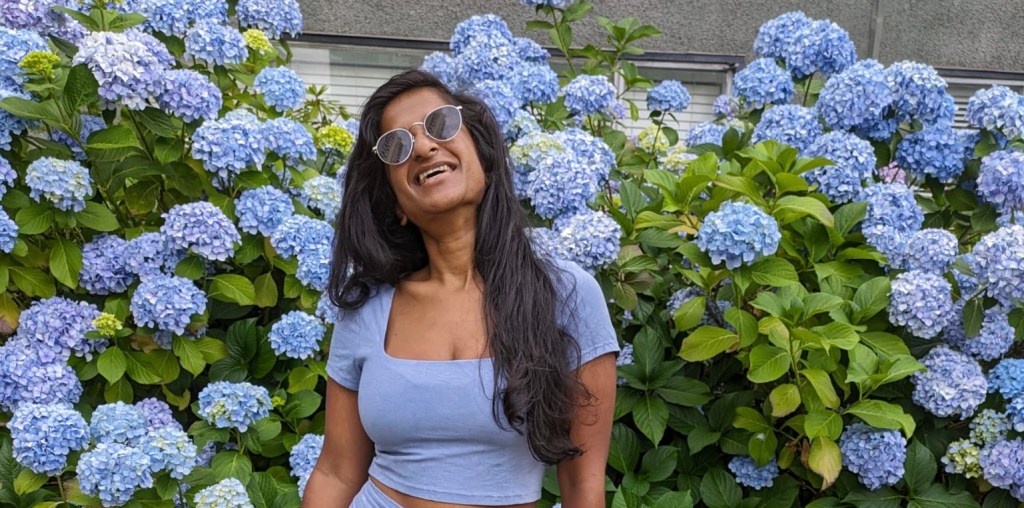
I wrote my first climate fiction story because of the 2004 tsunami that hit my home country of Sri Lanka, and I have never looked back. I’m currently working on a young adult science-fiction fantasy novel about queer BIPOC teenagers who learn about systems change from aliens and wield soul-destroying magical powers to save planet Earth. You’ll hear a lot about them here—especially on my blog, writing, and artwork pages.
A lot of my interests — fiction writing, academia, visual art, social media — focus on the intersections of climate change, communication, intersectional identities, and perspectives ignored in mainstream environmental thought. In particular, I like thinking about our emotional relationships with nature and each other in a climate-precarious world. What values do we prioritize, what fears do we give into, what narratives do we hold onto for hope, how do we fall in love?
I hold a Master’s degree in English Literature from University of British Columbia, where I wrote a SSHRC-funded thesis on Lord Byron, the four elements, and late capitalism in the Anthropocene. I double majored in English Literature and Professional Writing during my undergraduate career at University of Toronto Mississauga (and somehow won the department awards for both majors at graduation). Most of my career developed in university settings, writing and co-editing academic publications, conducting research on sustainability communication and food systems, running the social media for a university botanical garden. I currently work at UBC Press, where I’m following my love for scholarly publishing and discovering the intimate and wondrous world of Canadian publishing.
My master’s thesis focused on Lord Byron’s dramatic poem Manfred (pub. 1817). Why in the world, you may ask, would any eco-enthusiast read Byron of all people? Setting aside that Byron was a complete jerkhat, I wanted to think about how writers who don’t fall into the neat box of “nature poet” were and are constantly shunned from environmental discussions. If you read Manfred, you will find an eco-ethics in there that is nihilistic yet hopeful, misanthropic yet human-centric, judgmental yet sympathetic to the human condition of being powerfully powerless. How would our collective understanding of nature been different if mainstream (i.e. Eurocentric) environmental thought had never villainized human beings in the narrative of environmental degradation and climate change, but seen us as the solution from the start?
I live as an uninvited immigrant settler in Vancouver, BC, on the unceded and traditional homelands of the xʷməθkʷəy̓əm (Musqueam), sḵwx̱wú7mesh (Squamish), and sel̓íl̓witulh (Tsleil Waututh) nations. It’s really the ideal place to be constantly reminded of the beauty, history, and life at stake in our climate-chaotic world.
 Shalini Nanayakkara